Fuel in the oil on a Honda 1.5L turbo means gasoline has washed past the piston rings into the crankcase, thinning the oil and reducing its ability to protect the engine. This is commonly diagnosed as a direct-injection and cold-start issue, and it has been widely reported on roughly 2016-2020 CR-V, Civic, and Accord models with the 1.5T engine. If the dipstick smells like gas or reads above the full mark, take it seriously before it causes internal wear.
Which Honda Models Have This Issue?
The fuel-in-oil concern is commonly reported on the following vehicles equipped with the 1.5L turbocharged four-cylinder engine:
- 2017-2020 Honda CR-V (1.5T)
- 2016-2020 Honda Civic (1.5T, Sport Touring and EX-T trims)
- 2018-2020 Honda Accord (1.5T)
If you own one of these and drive mostly short trips in colder weather, read on. That driving pattern is exactly when this problem shows up.
What Is Oil Dilution and Why Does It Happen?
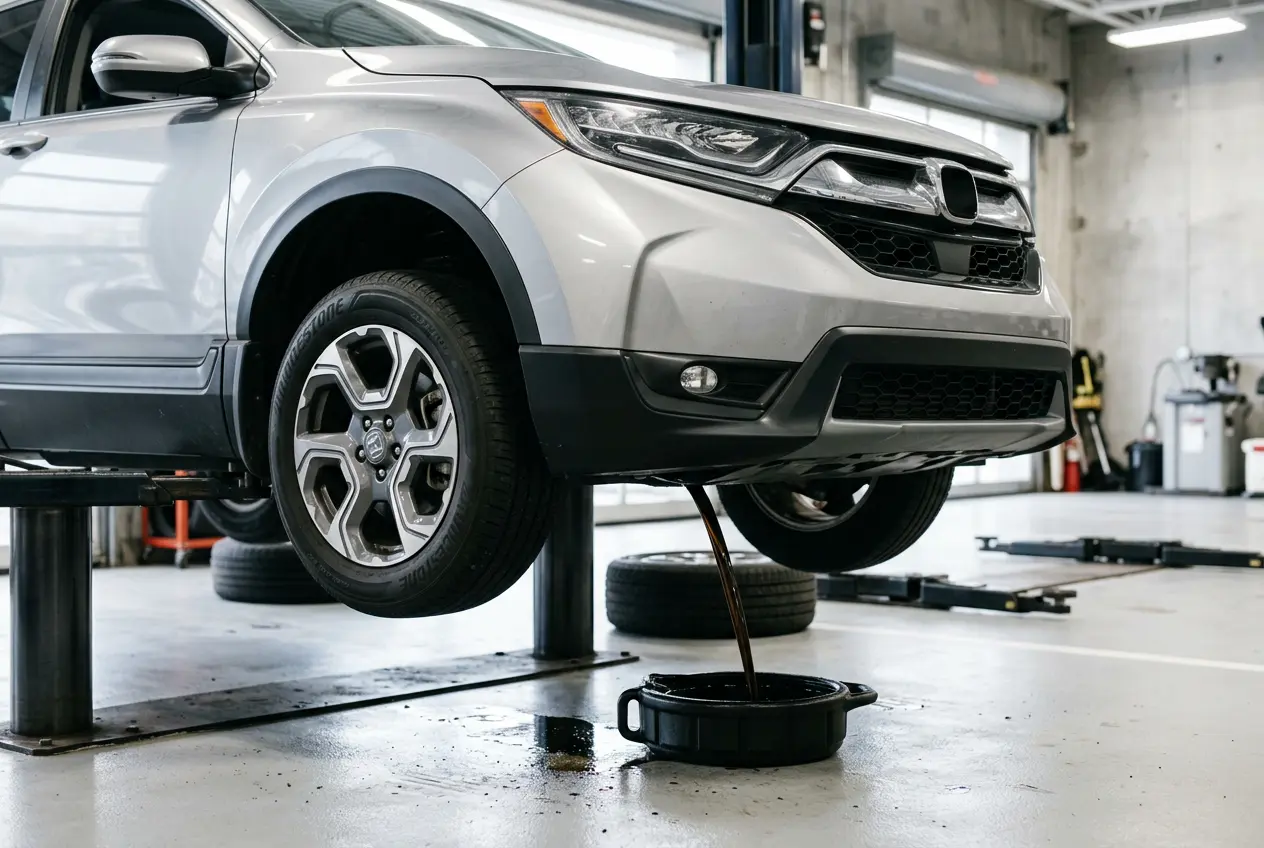
Oil dilution means fuel has mixed into the engine oil. On the 1.5T, the engine uses direct injection, meaning fuel is sprayed directly into the cylinder rather than into the intake port. During a cold start, some of that fuel can slip past the piston rings before the engine reaches full operating temperature. That fuel ends up in the oil pan.
The turbocharger adds to the problem. The engine runs a richer fuel mixture at low temperatures to protect the turbo and warm up faster. More fuel in the cylinder means more opportunity for it to slip past the rings before it burns completely.
Short trips make it worse. If the engine never gets fully warm, the fuel that washed into the oil never evaporates back out. Over time, the oil level rises and the oil loses its ability to protect the engine.
What Are the Symptoms of Fuel in the Oil?
Early Stage
The oil level creeps above the full mark on the dipstick. You may notice a faint gasoline smell when you check the oil. The engine may run slightly rough on cold starts but smooth out after a few minutes of driving.
Mid Stage
The gasoline smell on the dipstick is obvious. Oil changes are needed more frequently because the oil is breaking down faster. You may notice slightly reduced fuel economy. The engine may idle roughly in cold weather.
Late Stage
Heavily diluted oil loses its viscosity. It cannot form a proper film on engine bearings and cylinder walls. At this point, you risk accelerated wear on the crankshaft bearings, camshaft, and other internal parts. Repair costs climb significantly once internal wear sets in.
Is It Safe to Keep Driving?
No, not without addressing it first. Fuel-diluted oil does not lubricate the way clean oil does. Engine bearings and cylinder walls depend on proper oil film to survive. If the oil level is noticeably above full and smells like gas, change the oil before putting more miles on the engine. Continuing to drive on contaminated oil risks expensive internal damage.
What Makes This Worse in the DC Metro Area?
If you spend time sitting in Beltway traffic in August, you already know what DC-area summers do to a car. That wet, muggy heat stresses cooling systems and belts, and it also means more short, stop-and-go trips where the engine never fully warms up. Add in the freeze-thaw winters where temperatures hover right around 32 degrees and roads get salted repeatedly, and you have a climate that pushes this engine harder than the mileage alone would suggest. Short cold-weather commutes from Merrifield or Woodburn are exactly the kind of driving that accelerates this problem.
What Is the Recommended Fix?
The commonly recommended steps are:
- Immediate oil change to remove the fuel-contaminated oil and restore proper lubrication.
- Software reflash (ECU update) to adjust the fuel injection and warm-up strategy. A reflash changes how the engine manages fuel delivery during cold starts to reduce the amount of fuel that reaches the cylinder walls. Check with your dealer using your VIN to find out whether an applicable update exists for your vehicle.
- Driving habit adjustment where possible. Longer trips that allow the engine to reach full operating temperature help the oil do its job and allow any residual fuel to evaporate out of the crankcase.
A reflash does not eliminate the issue entirely in all cases, but it commonly reduces the rate of dilution for most drivers. Regular oil changes at shorter intervals are also recommended for owners who cannot avoid short-trip driving.
What Does This Repair Cost?
Cost depends on what the vehicle needs:
| Service | Typical Scope | What Moves the Price | Urgency |
|---|---|---|---|
| Oil change (contaminated oil) | Drain and refill with correct Honda-spec oil | Oil type (full synthetic required), filter brand | Do this first, before more driving |
| ECU software reflash | Connect scan tool, upload updated calibration | Whether the dealer or an independent shop performs it; check with your dealer about applicability to your VIN | High; reduces ongoing dilution |
| Follow-up oil changes (shorter interval) | More frequent changes while monitoring | How often dilution recurs after reflash | Ongoing |
| Internal engine inspection (if wear suspected) | Compression test, oil analysis, bearing check | Extent of wear found; whether parts are needed | If symptoms persist after reflash |
There is no single flat price for this repair without seeing the vehicle and knowing its history. What drives the cost most is whether the engine has already suffered wear from extended operation on diluted oil. Catching it early keeps the bill manageable. Bring the vehicle in for an inspection to get a straight answer on where it stands.
For more on what goes into an oil change and why oil specification matters on turbocharged engines, see our oil change service page and our post on how to choose the right motor oil.
Should I Check for a Recall on My Honda?
The recall status for this specific issue is not confirmed at this time. That can change. Run your VIN through the NHTSA recall lookup and check the Honda Owners site directly to see whether any open actions apply to your vehicle. If a recall applies to your VIN, the dealer performs that work. What we handle is the out-of-warranty diagnosis, oil service, and any follow-up engine work your vehicle needs.
For a broader look at what triggers a Virginia state inspection failure, see our post on the top hidden inspection issues Annandale drivers overlook.
Frequently Asked Questions
Is it safe to keep driving my Honda if there is fuel in the oil?
Short trips are risky. Fuel-diluted oil loses its ability to protect engine bearings and cylinder walls. Stop driving until the oil is changed and the underlying cause is addressed.
How do I know if my Honda 1.5 turbo has fuel in the oil?
Check the dipstick. If the oil level is higher than it was at the last change, or if you smell gasoline on the dipstick, fuel dilution is likely. A shop can confirm with a quick inspection.
Will an oil change fix the problem for good?
An oil change removes the contaminated oil, but it does not fix the root cause. A software reflash and changes to your driving habits (longer warm-up trips) are the commonly recommended steps.
Which Honda models are affected?
The issue is commonly reported on roughly 2016-2020 CR-V, Civic, and Accord models equipped with the 1.5L turbocharged engine. If you own one of these, it is worth checking.
Does Gallows Rd Automotive offer a warranty on this repair?
Yes. All parts and labor at Gallows Rd Automotive come with a 24-month/24,000-mile warranty.
Smell gas on your Honda’s dipstick? Bring it to Gallows Rd Automotive in Annandale. Brian Suarez, ASE Master Certified Technician with 30 years of diagnostic experience, will inspect the oil, confirm whether fuel dilution is present, and walk you through the next steps. All repairs carry our 24-month/24,000-mile parts and labor warranty. We also offer free shuttle rides so you are not stranded while the work gets done.
Call us at (703) 560-4500 or book an appointment online. We are open Monday through Friday, 8 a.m. to 5 p.m., at 3403 Holly Rd, Annandale, VA.
Also serving drivers from Falls Church, Mantua, and Dunn Loring.
Sources

Brian Suarez is a Master ASE Certified Technician with 30 years of automotive experience and specialized expertise in vehicle diagnostics. Throughout his career, Brian has built a reputation for accurately diagnosing complex issues and delivering dependable, high-quality repairs. His extensive technical knowledge and diagnostic skills help ensure every vehicle receives the expert care it deserves.